

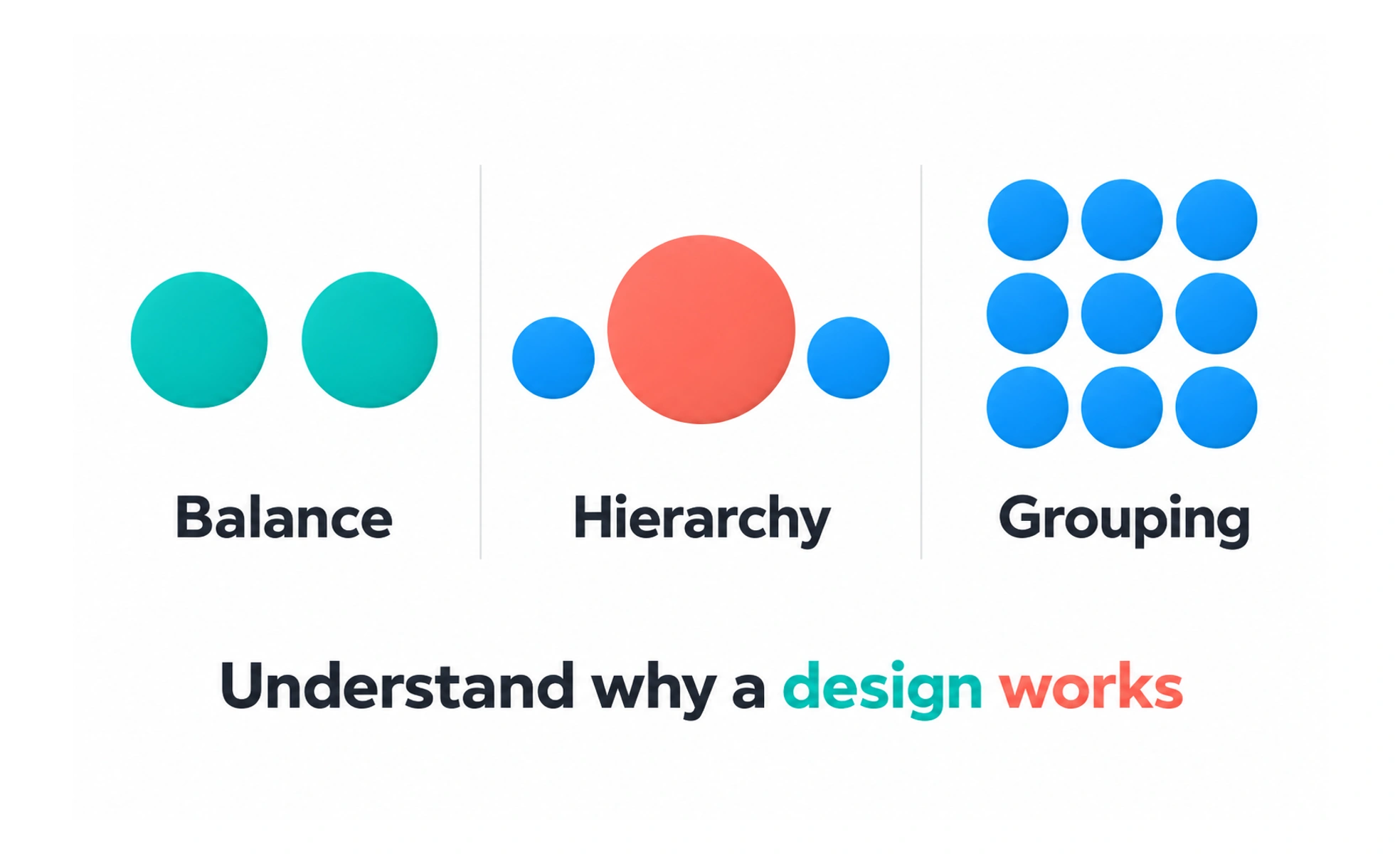
It unites Gestalt psychology, typography, compositional balance, scale and semiotics. Understanding these fundamentals helps designers create deliberate solutions rather than relying on guesswork.
Think of it like this. Learning musical theory does not replace playing an instrument, but it explains why certain harmonies sound beautiful and why dissonant chords feel tense.
How it works
Design theory synthesizes human perceptual psychology with structural visual principles.
- Gestalt principles explain how the human brain naturally organizes visual elements into unified groups.
- Visual hierarchy guides human eyes through layouts using contrasting scale, weight and positional prominence.
- Balance and symmetry distribute visual weight across screens to evoke stability or dynamic tension.
- Semiotics and symbology study how humans interpret icons, cultural metaphors and visual signifiers.
When to use it
Draw on design theory whenever you critique interfaces, solve novel layouts or justify decisions.
- Resolving visual clutter applies principles of proximity and similarity to group related controls cleanly.
- Articulating design rationale helps designers defend layout choices to stakeholders using established science.
- Evaluating brand identity ensures that visual choices authentically reinforce intended emotional tones.
- Creating new component libraries establishes mathematical harmony between spacing, radii and type scales.
Common mistakes
Practitioners often stumble by treating design theory as an academic abstraction.
- Treating theory as rigid dogma rather than adaptable guidelines that flex based on context and user testing.
- Prioritizing theoretical symmetry over practical software usability, placing artistic form ahead of real human workflows.
- Copying visual trends blindly without understanding the cognitive and perceptual principles that make them function.
Frequently asked questions
Key takeaways
- Design theory explains the psychological and perceptual rules underlying visual communication.
- Gestalt principles explain how people group visual elements by proximity, similarity and closure.
- Grounded theoretical knowledge lets designers articulate clear rationale to engineering and executives.
- Theoretical principles should always be validated against real user behavior and usability metrics.