

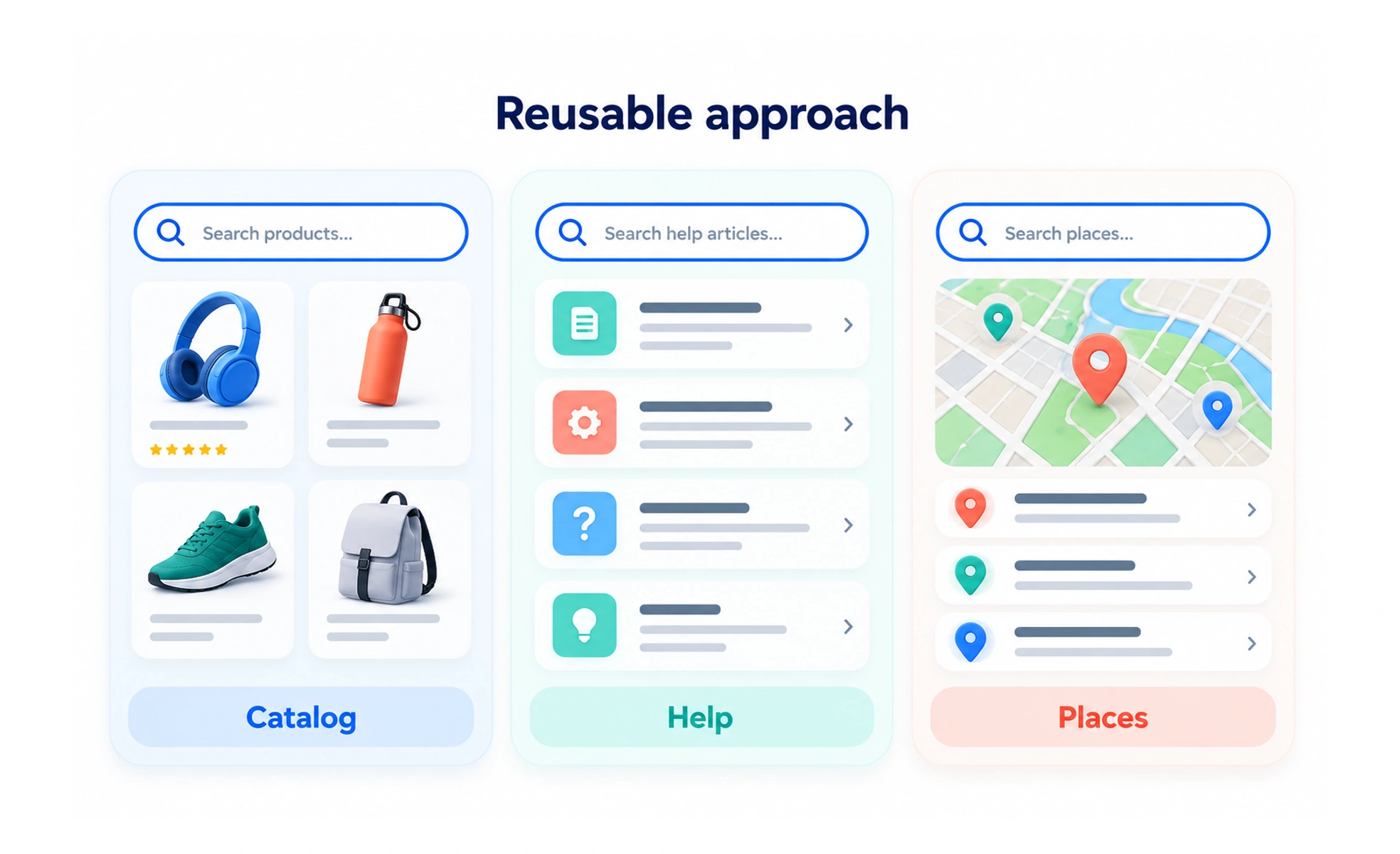
A pattern is useful because it captures reasoning that another team can apply. It is more than an attractive example or a component name. A searchable picker, for instance, addresses choosing from a long set of options, but adds keyboard, filtering and empty-state behavior that a short native select may not need.
Describe the problem before the solution
A practical pattern record explains the recurring problem, the conditions where it appears, the proposed approach and its consequences. Include examples without treating them as the only acceptable visual form.
A component is an implementation building block. A pattern can combine several components and service rules. A confirmation flow might involve a dialog, a summary, a pending state and a recoverable failure.
Choose by context
Ask whether the pattern solves the current task under the actual constraints.
- How frequently will people perform the task?
- How costly is a wrong choice, and can it be reversed?
- What works with a keyboard, screen reader or small viewport?
- What data and failure states must the approach support?
Familiarity can reduce the amount people need to learn, but an established pattern can still be inappropriate. A destructive action with serious consequences may need more explanation than a reversible preference change.
Example: progressive disclosure
A shipping form shows the common address fields and places an optional delivery note behind a clearly labeled control. This keeps the usual task concise while preserving a route for additional information.
The pattern fails if a field that most people need is hidden, or if revealing it changes the page in a way that loses focus. The decision depends on actual usage and accessible interaction, not a general preference for fewer visible fields.
Adapt and validate
Use a pattern as a starting hypothesis. Test the uncertain parts and record what changed for your product. In a design system, document the approved behavior and the cases that require a different approach.
Avoid copying an entire competitor workflow because it looks familiar. Their audience, entitlement rules and operational constraints may differ from yours.
Frequently asked questions
Key takeaways
- A useful pattern explains context and consequences as well as a solution.
- Patterns can span several components and product rules.
- Check accessibility, failure states and reversibility when choosing a pattern.
- Validate the fit rather than assuming familiarity guarantees success.