

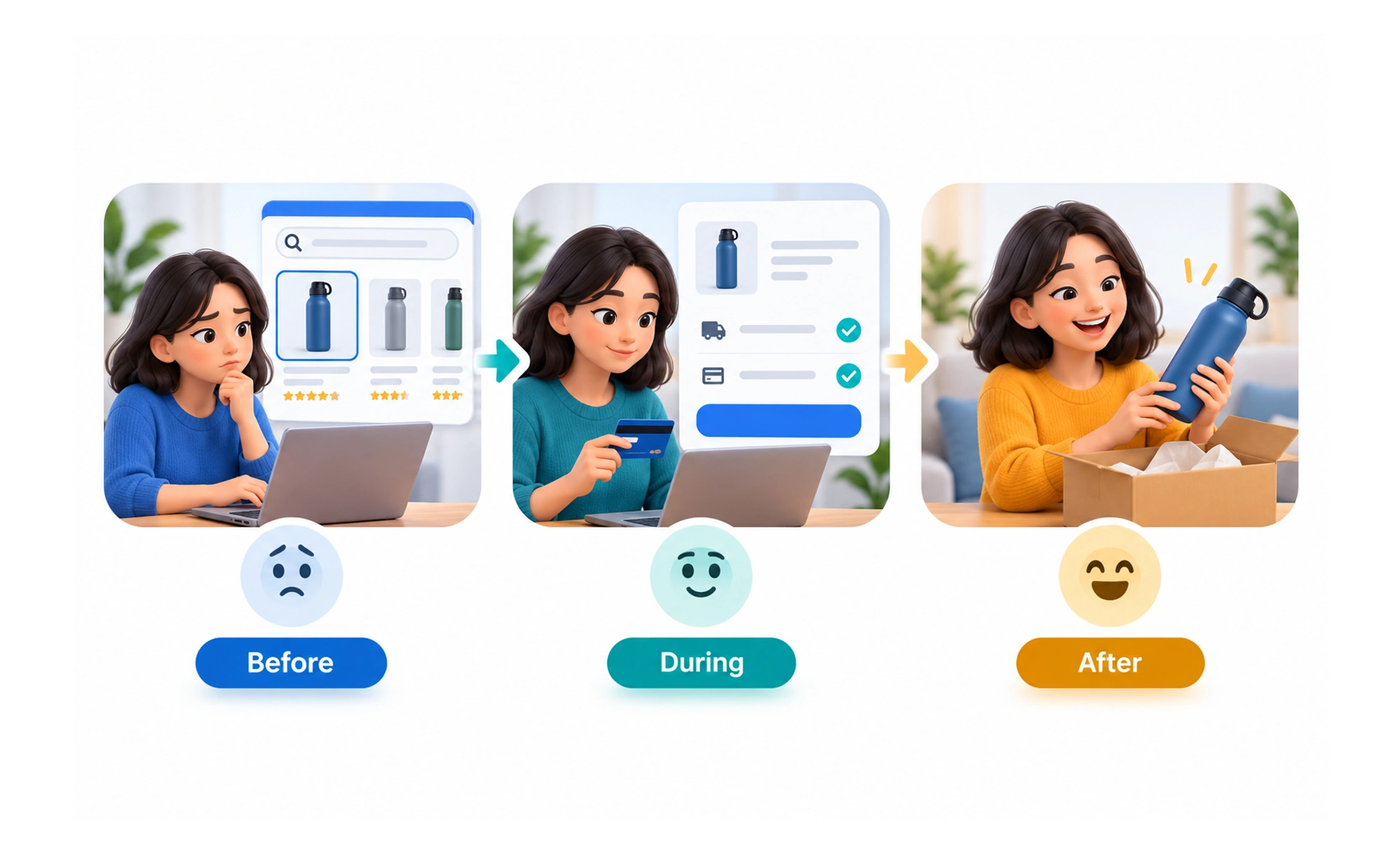
Experience includes the interface, but also the promises, delays, policies and outcomes around it. A polished booking form can still produce a poor experience if the price changes at checkout or cancellation is difficult. Evaluate the whole task in the person’s actual context.
Look beyond the screen
People bring goals, prior knowledge, abilities and expectations to a service. The same design can work well for an experienced user at a desk and poorly for a newcomer using a phone outdoors.
Consider what happens before use, during use and afterwards. Marketing sets expectations; interaction determines whether the task is possible; receipts, support and later outcomes influence how the service is remembered.
Turn experience into observable questions
“Make it delightful” does not identify a problem the team can investigate. Ask concrete questions instead.
- Can people tell whether the service is suitable before committing?
- Can they complete the important task with the access methods they use?
- Do labels, prices and outcomes match their expectations?
- Can they recover from mistakes without losing work?
Combine observed task behavior with people’s explanations and relevant service data. Completion alone does not establish confidence, trust or satisfaction.
Example: a delivery tracking service
A tracking page may be fast and readable yet show an estimated arrival time that never updates. People repeatedly check it because the information is unreliable. Adding a smoother animation will not fix that experience.
A better intervention could explain uncertainty, update the estimate when circumstances change and provide a useful action when the delivery is late. The design decision includes service behavior as well as presentation.
Separate the experience from the discipline
UX is the experience being studied. UX design is the practice of shaping the conditions that influence it. Teams can improve those conditions, but they cannot prescribe an identical feeling for every person.
Avoid reducing UX to a single score or ownership by one department. Research, engineering, operations, content and support can all change the experience.
Frequently asked questions
Key takeaways
- Evaluate the complete task and service, not only interface appearance.
- Context and expectations change how a design is experienced.
- Use specific questions and evidence to locate the problem.
- UX describes the experience; UX design describes a practice for improving it.